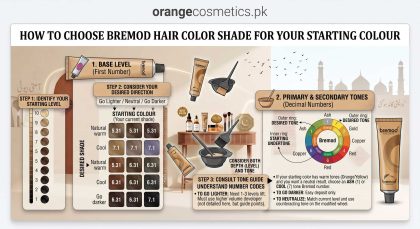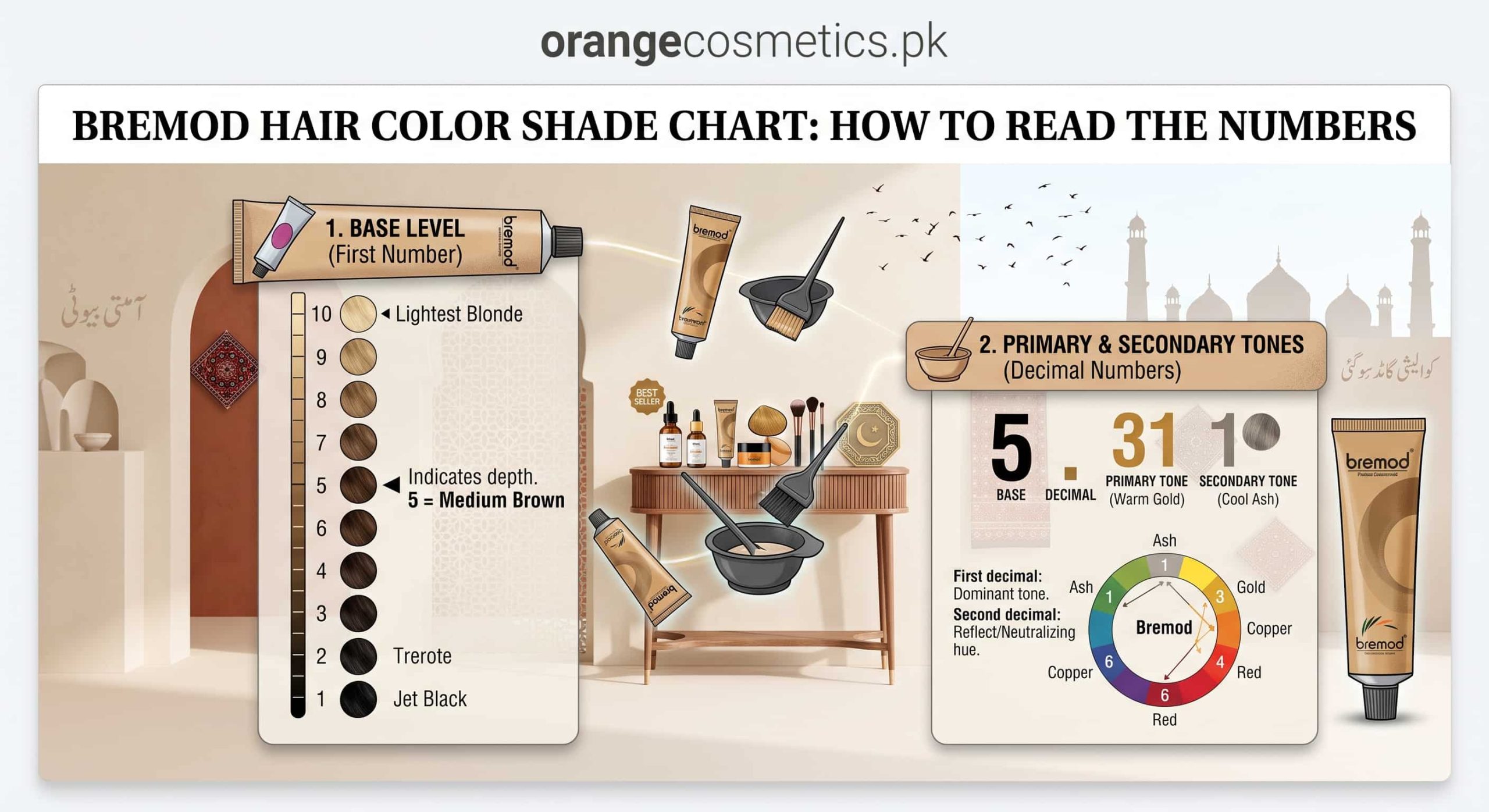
A Bremod hair color shade chart uses numbers to identify the approximate depth and tone of each color. In a shade such as 6.3, the first number indicates the general color level, while the number after the decimal helps distinguish the tone. In this example, Bremod identifies 6.3 as Dark Gold Blond.
The number is only a shade reference. It does not guarantee that every person will achieve the same result because the final color also depends on the starting hair color, previous dye, grey percentage, hair condition and application method.
Use this guide to understand the numbers before browsing Bremod hair colors in Pakistan.
Quick Bremod Hair Color Shade Chart
The following shades are useful for understanding the basic level progression in Bremod’s current range.
| Bremod shade number | Shade name | General depth |
|---|---|---|
| 2.0 | Black | Very dark |
| 3.0 | Dark Brown | Dark brown |
| 4.0 | Medium Brown | Medium brown |
| 5.0 | Light Brown | Light brown |
| 6.0 | Dark Blond | Dark blonde level |
| 7.0 | Medium Blond | Medium blonde level |
| 8.0 | Light Blond | Light blonde level |
| 9.0 | Lighter Blond | Lighter blonde level |
These names follow Bremod’s current product listings. Bremod also offers additional natural, ash, gold, copper, red, purple and fashion shades. The brand’s printed shade card currently covers 63 shades. View Bremod’s official shade-card information.
Always check the exact shade name printed on the product before purchasing because special codes do not necessarily follow the standard decimal pattern.
How to Read the Bremod Hair Color Shade Chart
For many standard Bremod shades, the code contains two main parts:
First number: approximate color depth
Number after the decimal: the shade’s tonal direction
Take shade 6.3 as an example:
- 6 indicates a dark blonde depth
- .3 identifies a golden tonal direction
- Bremod names the complete shade Dark Gold Blond 6.3
Now compare it with 6.1:
- 6 again indicates a dark blonde depth
- .1 distinguishes an ash tone
- Bremod names it Dark Ash Blond 6.1
Both colors sit at approximately the same depth, but they belong to different tonal families. One appears warmer and more golden, while the other is intended to appear cooler and ashier.
What Does the First Number Mean?
The first number helps you estimate how dark or light the shade is.
A lower number generally represents a darker shade. A higher number generally represents a lighter shade.
| Level | Bremod example | What the level indicates |
|---|---|---|
| 2 | Black 2.0 | Very dark color |
| 3 | Dark Brown 3.0 | Dark brown |
| 4 | Medium Brown 4.0 | Medium brown |
| 5 | Light Brown 5.0 | Lighter brown |
| 6 | Dark Blond 6.0 | Dark blonde |
| 7 | Medium Blond 7.0 | Medium blonde |
| 8 | Light Blond 8.0 | Light blonde |
| 9 | Lighter Blond 9.0 | A lighter blonde level |
The level name describes the shade within the manufacturer’s color system. It may not match how the color appears on every person.
For example, a shade labelled dark blonde may look brown on naturally dark hair or in indoor lighting. Hair-color terminology often places colors at lighter levels than the names people use in everyday conversation.
What Does .0 Mean in Bremod Hair Color?
In Bremod’s standard level range, shades ending in .0 are the core depth shades.
Examples include:
- 2.0 Black
- 3.0 Dark Brown
- 4.0 Medium Brown
- 5.0 Light Brown
- 6.0 Dark Blond
- 7.0 Medium Blond
- 8.0 Light Blond
- 9.0 Lighter Blond
These are useful reference points when you want to compare how light or dark two shades are without first focusing on ash, gold, copper or red tones.
A .0 shade is not automatically the best choice for every person seeking a natural result or grey coverage. Follow the product instructions and ask a professional colorist when the existing hair contains multiple colors, resistant grey or previous chemical treatments.
What Does .1 Mean in Bremod Hair Color?
Bremod uses .1 in several ash shades.
Verified examples from the current Bremod range include:
| Shade | Bremod name | General appearance |
|---|---|---|
| 6.1 | Dark Ash Blond | Dark blonde with a cooler ash direction |
| 7.1 | Medium Ash Blond | Medium blonde with an ash direction |
Ash shades are generally selected when someone prefers a cooler-looking result or wants to avoid an overly golden appearance.
However, an ash number does not guarantee that it will completely remove orange, red or yellow tones. Neutralising unwanted warmth depends on:
- The existing level
- The underlying pigment
- Previous color
- Whether the hair has been lightened
- Hair porosity
- The chosen formula
- Processing and developer instructions
Applying a lighter ash color over dark hair does not necessarily create the light, cool result shown on a shade swatch.
What Does .3 Mean in Bremod Hair Color?
Bremod uses .3 for golden shades.
Examples include:
| Shade | Bremod name | Tonal direction |
|---|---|---|
| 6.3 | Dark Gold Blond | Dark blonde with gold warmth |
| 7.3 | Golden Brown | Warm golden brown |
| 8.3 | Light Golden Brown | Lighter golden brown |
Golden shades can add visible warmth and richness. They may be suitable for people who prefer caramel, honey or warm-brown effects rather than grey or smoky tones.
The first number remains important. Shades 6.3, 7.3 and 8.3 may share a golden family, but they do not have the same depth.
How Are Double Tone Numbers Read?
Some Bremod shades contain two numbers after the decimal, such as:
- 6.31 Golden Ash Blond
- 6.33 Dark Golden Brown
- 7.31 Light Golden Ash Blond
- 7.33 Dark Golden
- 7.66 Medium Intense Red Blond
A double number usually indicates a more specific tonal combination or an intensified tone.
For example:
- 6.31 is named Golden Ash Blond by Bremod
- 7.31 is named Light Golden Ash Blond
- 7.66 is named Medium Intense Red Blond
Do not assume that every double number can be decoded using a universal chart from another hair-color brand. Numbering systems can differ between manufacturers, and Bremod also carries special shades whose codes do not fit a simple level-and-tone formula.
Use the complete Bremod shade name as the final reference.
Bremod Brown Shade Reference
For shoppers interested in brown hair colors, these are some of the most useful shade families to compare.
| Shade number | Bremod shade name | Color family |
|---|---|---|
| 3.0 | Dark Brown | Deep brown |
| 4.0 | Medium Brown | Medium brown |
| 5.0 | Light Brown | Light brown |
| 5.5 | Coco | Warm brown family |
| 6.3 | Dark Gold Blond | Golden dark blonde or light-brown effect |
| 6.5 | Coffee Brown | Coffee-brown family |
| 7.3 | Golden Brown | Warm golden brown |
| 55/41 | Chocolate Brown | Special chocolate-brown code |
The expected visual result depends heavily on the starting base.
A medium or golden brown shade applied to very dark untreated hair may create subtle warmth rather than the brighter result visible on a printed swatch. Previously lightened hair may accept the same color more visibly but can also process unevenly when porosity varies.
Bremod Blonde Shade Reference
The main blonde levels include:
| Shade number | Bremod shade name |
|---|---|
| 6.0 | Dark Blond |
| 6.1 | Dark Ash Blond |
| 6.3 | Dark Gold Blond |
| 7.0 | Medium Blond |
| 7.1 | Medium Ash Blond |
| 8.0 | Light Blond |
| 9.0 | Lighter Blond |
The word “blond” on a hair-color chart describes a professional color level. It does not mean that dark hair will become blonde simply because a lighter shade is applied.
How much change is possible depends on the existing pigment, whether the hair is natural or previously colored, and the application system specified by the manufacturer.
Previously dyed dark hair can be particularly difficult to lighten evenly. A professional assessment is safer when a major change is required.
Bremod Red, Copper and Purple Shade Examples
Bremod’s range also includes more visible fashion and warm tones.
| Shade number | Bremod shade name |
|---|---|
| 0.66 | Red |
| 3.66 | Deep Damson |
| 4.22 | Dark Purple |
| 4.5 | Red Chestnut |
| 5.4 | Dark Copper |
| 5.45 | Rich Burgundy Red |
| 5.56 | Mahogany |
| 5.66 | Purplish Red |
| 6.4 | Medium Copper |
| 6.45 | Medium Burgundy Red |
| 6.62 | Grape Purple |
| 7.4 | Light Copper |
| 7.45 | Floweriness Red |
| 7.56 | Light Mahogany |
| 7.66 | Medium Intense Red Blond |
Fashion shades and intense colors can behave differently depending on the base. A red or purple shade applied to dark hair may appear as a reflection under bright light. The same shade on lighter or pre-lightened hair may appear much more vivid.
Because Bremod’s expanded range includes special codes, always match the code to the complete name on the tube or official card.
What Do Special Codes Such as 0.66, 0.88 and 55/41 Mean?
Not every Bremod product follows the standard pattern used by shades such as 5.0 or 6.3.
Examples include:
- 0.66 Red
- 0.88 Blue
- 55/41 Chocolate Brown
- 7N Blond
- H66 Purple
- 12.22 Ash Blond Green
These should be treated as specific product codes rather than decoded only through the basic level chart.
A product beginning with zero may be a strong fashion or corrective color rather than a conventional natural depth. Codes containing letters, slashes or unusually high numbers may belong to a special color family or series.
Before buying one of these shades:
- Read the complete shade name.
- Check the current Bremod shade card.
- Review the instructions on the product.
- Confirm whether the shade is designed for direct use, mixing or professional color correction.
- Ask a trained colorist if the purpose is unclear.
Do not substitute a generic color-number chart from another manufacturer.
Why the Same Bremod Shade Can Look Different on Two People
A shade swatch shows the intended color direction, not an identical guaranteed outcome.
The result can change because of:
Starting hair color
Dark hair contains more underlying pigment than light hair. The same formula may produce a subtle reflection on one base and a visible color change on another.
Natural or previously colored hair
Hair color does not always lift previously applied permanent dye in the same way it affects untreated hair. Existing artificial pigment can limit or alter the result.
Grey percentage
A small amount of grey, resistant grey and predominantly grey hair can respond differently to the same formula.
Hair porosity
Porous areas may absorb color more strongly or release it more quickly. Roots, mid-lengths and ends may therefore develop differently.
Previous treatments
Bleaching, rebonding, perming, keratin treatments, henna and repeated coloring can affect both color predictability and hair condition.
Product mixture and application
The selected developer, mixing ratio, processing time and application sequence can change the result. Follow the instructions supplied with the exact product rather than copying a formula from an unrelated brand or social-media video.
Lighting and screens
Warm indoor lighting, sunlight, camera settings and screen calibration can all change how a shade appears in photographs.
How to Choose a Bremod Shade
Use this five-step selection process.
Step 1: Identify your current level
Compare your hair with the natural depth range:
- Black
- Dark brown
- Medium brown
- Light brown
- Dark blonde
- Medium blonde
- Light blonde
Check the roots and lengths separately if the hair has been colored before.
Step 2: Decide whether you want to stay similar, go darker or go lighter
Staying at a similar level or going darker is generally more predictable than trying to make dark or previously colored hair significantly lighter.
A dramatic change may require professional lightening, color correction or more than one appointment.
Step 3: Choose a tonal direction
Decide whether you prefer:
- Natural
- Ash or cool
- Gold or warm
- Copper
- Red
- Burgundy
- Purple
- Chocolate or coffee brown
Step 4: Match the complete shade name
Do not select a tube using only one digit. Confirm that both the number and printed shade name match your intended result.
For example:
- 6.0 is Dark Blond
- 6.1 is Dark Ash Blond
- 6.3 is Dark Gold Blond
- 6.4 is Medium Copper
- 6.5 is Coffee Brown
All begin at level 6, but their tonal directions differ.
Step 5: Check suitability and instructions
Read the product packaging for:
- Mixing directions
- Required developer
- Processing time
- Allergy-test instructions
- Application method
- Warnings
- Grey-coverage guidance
- Restrictions involving previous treatments
Consult a professional when the hair is damaged, unevenly colored, previously treated with henna or expected to change by several levels.
Should You Choose a Shade From a Phone Screen?
Use online images for narrowing your choices, not for making a precise final color match.
Phone screens can alter:
- Brightness
- Warmth
- Contrast
- Saturation
- Red and violet intensity
- The difference between ash and natural tones
For a closer reference, compare the official physical shade card in neutral lighting. A physical swatch is still only an approximation because the hair’s starting condition affects the result.
Bremod states that its printed card contains swatches for 63 shades, including natural browns, blondes, reds and purples. The current official product collection also lists shades such as 5.0 Light Brown, 6.0 Dark Blond, 6.1 Dark Ash Blond and 7.1 Medium Ash Blond. View Bremod’s current hair-color range.
Hair Color Safety Checklist
Before applying any permanent or oxidative hair color:
- Read all product directions
- Perform the allergy test required by the product
- Wear gloves
- Do not use the color on an irritated or damaged scalp
- Keep the product away from the eyes
- Do not use scalp hair dye on eyebrows or eyelashes
- Do not exceed the instructed processing time
- Rinse thoroughly as directed
- Keep hair dye away from children
- Stop immediately if a serious reaction develops
The FDA recommends performing a skin patch test every time hair dye is used, even if the same product has been used previously. It also advises following the package directions, wearing gloves and avoiding application on an irritated or damaged scalp. Read the FDA hair-dye safety guidance.
If you have experienced a previous hair-dye reaction or have a sensitive scalp, seek professional medical or dermatological advice before applying another color.
Frequently Asked Questions
What does 5.0 mean in Bremod hair color?
Bremod identifies 5.0 as Light Brown. The number 5 indicates the depth, while .0 places it within the core shade range.
What is Bremod shade 6.1?
Bremod 6.1 is Dark Ash Blond. It is at a similar depth to 6.0 Dark Blond but has an ash tonal direction.
What is Bremod shade 6.3?
Bremod 6.3 is Dark Gold Blond. The 6 represents the depth, while .3 indicates the golden direction used in this shade.
What is the difference between Bremod 6.0 and 6.1?
Both shades are at level 6. Bremod 6.0 is Dark Blond, while 6.1 is Dark Ash Blond. The ash version has a cooler tonal direction.
What is the difference between Bremod 6.1 and 7.1?
Both belong to the ash family. Bremod 6.1 is Dark Ash Blond, while 7.1 is Medium Ash Blond. The level 7 shade is positioned one step lighter on the chart.
Which Bremod shade is light brown?
Bremod identifies 5.0 as Light Brown.
Which Bremod shade is medium brown?
Bremod identifies 4.0 as Medium Brown.
Which Bremod shade is dark brown?
Bremod identifies 3.0 as Dark Brown.
Can Bremod blonde color make black hair blonde?
A lighter shade number does not guarantee that naturally black or previously colored dark hair will become blonde. The outcome depends on the base, existing artificial pigment, developer, hair condition and whether professional lightening is required.
Can two Bremod shades be mixed?
Do not mix shades based only on online formulas. Use combinations and ratios supported by Bremod’s instructions or recommended by a trained professional. Different mixtures can create unexpected tones or uneven results.
Final Shade Selection Checklist
Before ordering a Bremod hair color, confirm:
- Your current natural and dyed color
- The level you want to achieve
- Whether you prefer a warm, cool or neutral result
- The exact shade number
- The complete shade name
- Whether your hair has previous dye or chemical treatment
- Whether grey coverage is required
- The correct application instructions
- The required allergy test
- Whether professional help is advisable
The Bremod hair color shade chart makes the range easier to understand, but it cannot predict the final result on every head of hair. Read the first number as the approximate depth, use the remaining code to identify the shade family, and confirm the complete product name before purchasing.
You can compare the available range through Orange Cosmetics, then use the product label and official shade card as the final application references.